
The keyword content://cz.mobilesoft.appblock.fileprovider/cache/blank.html often appears unexpectedly and can confuse users who are not familiar with Android system structures. When people see this string on their device, browser, or app activity log, they usually assume something is broken, malicious, or unsafe. In reality, this path is a technical reference used by Android applications to manage internal content securely.
Understanding content://cz.mobilesoft.appblock.fileprovider/cache/blank.html requires a basic awareness of how Android handles files, permissions, and app-level content sharing. Unlike traditional web URLs, content paths are part of Android’s internal content provider system. They are not meant to be opened manually, indexed by search engines, or interacted with by users in the same way as websites.
This article explains what content://cz.mobilesoft.appblock.fileprovider/cache/blank.html is, why it exists, how it is used, and whether it poses any risk. The goal is to remove confusion and give you a clear, structured understanding of this technical keyword.
What content:// Means in Android
To understand content://cz.mobilesoft.appblock.fileprovider/cache/blank.html, you must first understand the content:// scheme itself. Android uses content URIs as a secure method for apps to share files and data internally without exposing raw file paths.
Unlike file-based paths that directly reference storage locations, content paths act as controlled gateways. Apps request access through permissions rather than direct file access. This protects sensitive data and prevents misuse.
When you see content://, it usually means the system or an app is referencing internal content rather than a public resource. This is normal behavior in modern Android versions where security and sandboxing are strict.
So the presence of content:// in content://cz.mobilesoft.appblock.fileprovider/cache/blank.html already tells us that this is a system-level or app-level internal reference.
Breaking Down the Full Path
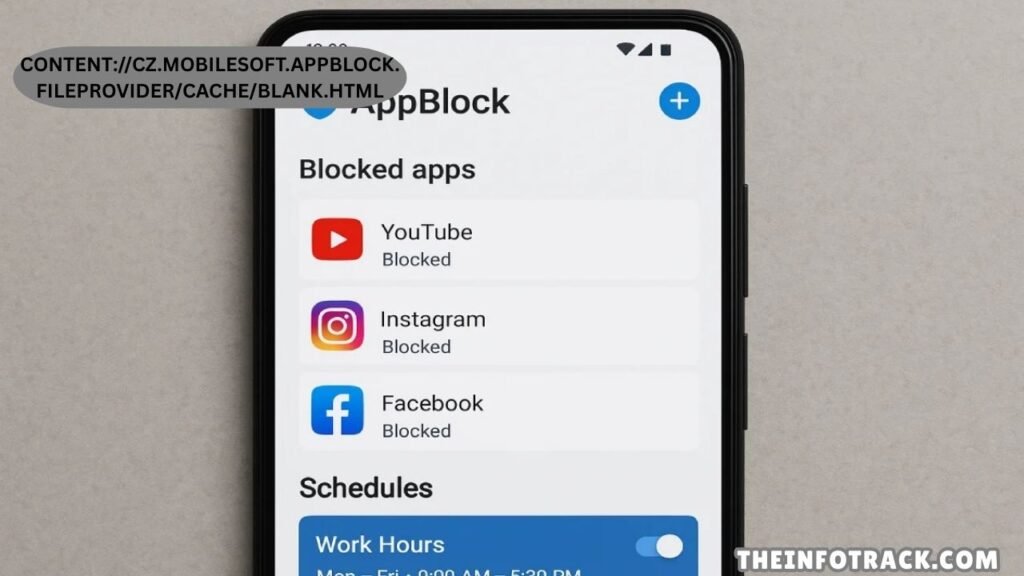
Let’s examine content://cz.mobilesoft.appblock.fileprovider/cache/blank.html step by step to understand its role.
The package identifier cz.mobilesoft.appblock belongs to an Android application commonly associated with app usage control or blocking behavior. The term fileprovider indicates that the app is using Android’s FileProvider mechanism to serve files securely. The cache directory refers to temporary storage used by the app. The file blank.html is a lightweight placeholder file.
Put together, content://cz.mobilesoft.appblock.fileprovider/cache/blank.html represents a temporary internal HTML file served by the app to control or redirect content behavior within the device.
This is not a website, not a virus, and not something designed for direct user interaction.
Why blank.html Is Used
The blank.html file referenced in content://cz.mobilesoft.appblock.fileprovider/cache/blank.html serves a very specific purpose. It is commonly used as a neutral or empty page.
In app-blocking or focus-related applications, a blank page is often loaded intentionally to replace restricted content. Instead of showing a blocked website or app screen, the system loads an empty HTML page.
This approach prevents visual distractions, stops content from loading, and avoids error messages that might encourage users to bypass restrictions. It is a clean and effective control method.
Therefore, blank.html is not an error. It is a design choice.
Role of App Blocking Systems
Applications that manage focus, productivity, or parental control need a way to override content safely. content://cz.mobilesoft.appblock.fileprovider/cache/blank.html is part of that control mechanism.
When a restricted app or site is accessed, the system does not crash or force-close. Instead, it redirects the request internally to a neutral resource. This keeps the device stable and prevents repeated access attempts.
From a technical standpoint, this method is safer than blocking at the network level because it operates entirely within the Android permission system.
Why Users Encounter This Path
Most users do not intentionally search for content://cz.mobilesoft.appblock.fileprovider/cache/blank.html. It usually appears in one of the following situations.
Users may see it in browser address bars when a site is blocked. Developers may encounter it in debugging logs. Advanced users may find it while reviewing device activity. Sometimes it appears in screen reports or accessibility logs.
In all these cases, the appearance of this path indicates that a blocking or redirection rule is working as intended.
Is content://cz.mobilesoft.appblock.fileprovider/cache/blank.html Safe
Safety is a common concern when users encounter unfamiliar system paths. content://cz.mobilesoft.appblock.fileprovider/cache/blank.html is safe.
It does not execute harmful code. It does not transmit personal data externally. It does not function outside the app’s sandbox. It exists only within the scope of the application that created it.
Because it uses Android’s FileProvider framework, access is restricted and controlled. Other apps cannot freely read or manipulate this file unless explicitly allowed by permissions.
From a security standpoint, this is a best-practice implementation.

Difference Between content:// and http://
One reason for confusion is that content paths look similar to web URLs. However, content://cz.mobilesoft.appblock.fileprovider/cache/blank.html is fundamentally different from http or https addresses.
Web URLs point to online resources hosted on servers. Content URIs point to local resources managed by Android applications. They do not rely on internet connectivity and are not accessible outside the device environment.
This distinction is important. Attempting to open content paths in external browsers or search engines will not work and is not intended to work.
Cache Directory Purpose
The cache folder referenced in content://cz.mobilesoft.appblock.fileprovider/cache/blank.html indicates temporary usage. Cache files are designed to be disposable.
Android may clear cache files automatically to free storage. Apps recreate them when needed. This means blank.html may appear and disappear over time.
Its presence does not indicate permanent storage or tracking. It is simply a functional placeholder used when required.
When This Path Might Change
While content://cz.mobilesoft.appblock.fileprovider/cache/blank.html is a common format, variations can occur depending on app updates or Android versions.
The file name may change. The cache location may refresh. The package name remains consistent unless the app is replaced or removed.
These changes are normal and should not be interpreted as system errors.
Should Users Delete or Modify It
Users should not attempt to manually delete or modify content://cz.mobilesoft.appblock.fileprovider/cache/blank.html.
Because it is managed internally by the app, manual interference can cause unexpected behavior such as app crashes or broken blocking rules.
If users want to stop seeing this path, the correct solution is to adjust the app’s settings, disable blocking rules, or uninstall the application responsibly.
Common Misconceptions
Many people believe that content://cz.mobilesoft.appblock.fileprovider/cache/blank.html is spyware or malware. This is incorrect.
Others think it means their phone is hacked. This is also incorrect.
Some believe it is a broken website. In reality, it is a successful redirection.
Understanding these misconceptions helps reduce unnecessary concern.
Why This Keyword Is Searched Online
The reason content://cz.mobilesoft.appblock.fileprovider/cache/blank.html appears in searches is simple. Users are curious and confused when unfamiliar technical strings appear on their devices.
Search behavior reflects uncertainty, not danger. This makes clear explanations essential.
Conclusion
content://cz.mobilesoft.appblock.fileprovider/cache/blank.html is an internal Android content reference used by app blocking systems to redirect or replace restricted content with a neutral blank page. It operates through Android’s secure FileProvider framework and exists temporarily in the app’s cache directory.
It is safe, intentional, and functional. It does not represent malware, data leaks, or system failure. Instead, it indicates that a control mechanism is working correctly.
By understanding how content paths work and why blank.html is used, users can feel confident and informed rather than alarmed. This clarity removes confusion and helps people trust the systems designed to support focus, security, and device stability.
Also read: How to Keep Dudokkidzo Care Tips, Routine and Maintenance